8-8 Miya, The Bear Little Girl
Tap the text to show or hide reading controls.
Miya was a five-year-old bear little girl.
She was another kid who liked making clothes.
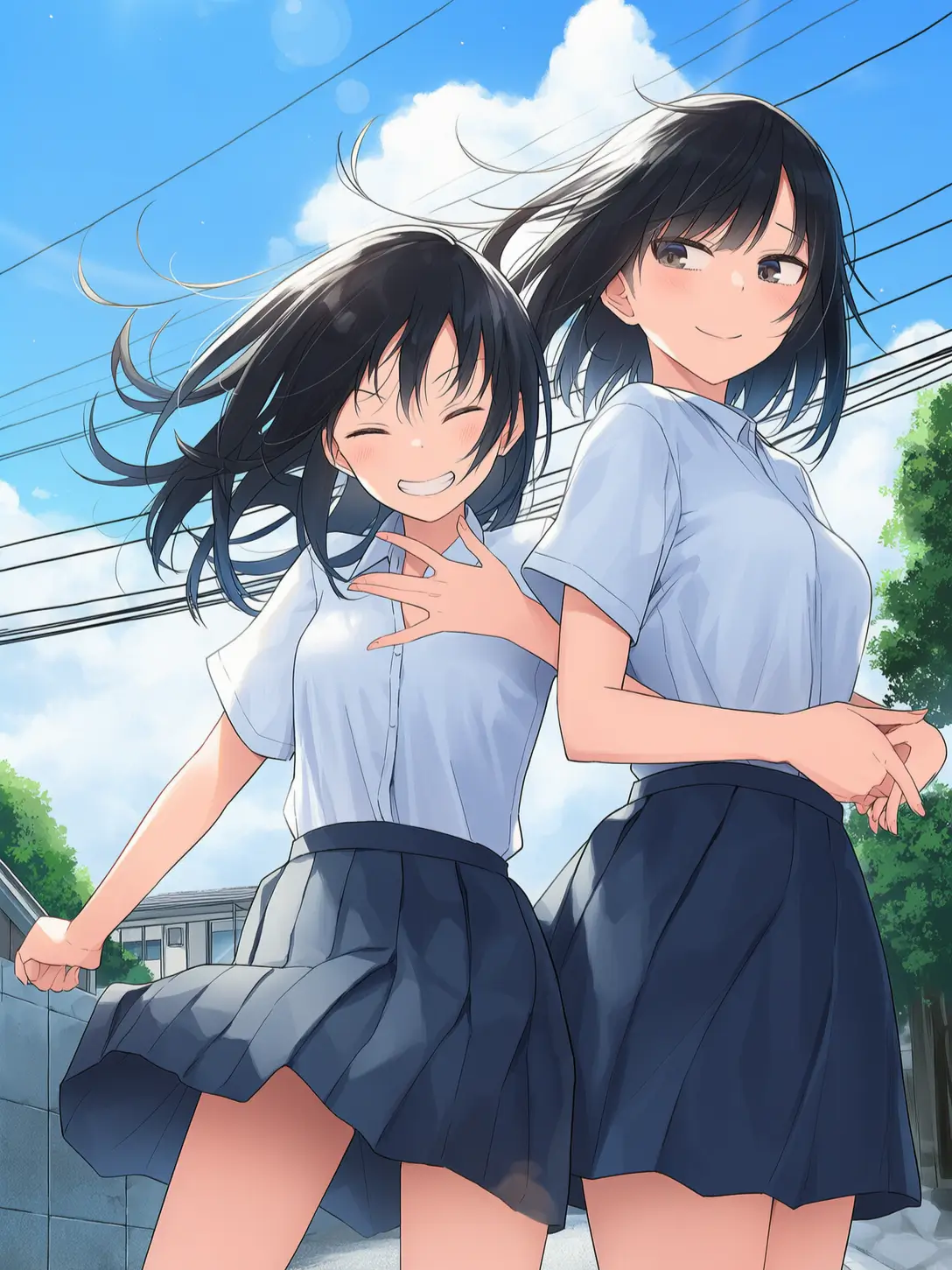
She had long black hair, and her eyes were black too.
That was a perfectly “rare visitor” color scheme.
Since their coloring matched, she often hung out with the lucky black-cat siblings.
Maybe her interest in clothes came from being self-conscious about her bear tail.
Unlike the other kids’ long, slender tails, hers was different, so it felt like she had to think about a lot of things.
She was pretty good at cutting out patterns.
Sewing them together did not seem to go very well yet, but she did not get discouraged and kept trying.
Then some unexpected support arrived.
It was Lisa-san, Eri’s mother.
“I have three children, you know. I’m constantly making clothes or mending them. Eri was a little tomboy when she was small. Before I got sick, I even did seamstress work.”
Come to think of it, I met Eri in the dungeon at first.
If she had been a truly quiet, proper girl, she would never have gone into a dungeon no matter what.
Everyone got careful lessons in clothes-making, and before long she was being called “Lisa-sensei,” with the kids totally attached to her.
And when she had time, she said she would come again.
She looked happy too, which was the best part.
I appraised her again after a long while, and I felt relieved that her illness did not seem to have returned.
The little girls were glued to the sewing machine.
Even little Remi was standing on top of the sewing machine table.
Was she trying to say, “Compared to that tower (the slide), this is nothing”?
She still seemed stuck in “summit conqueror” mode.
Maybe I would make a jungle gym for them someday.
“Headmaster-teacher, this is too big and I can’t use it!”
“It’s for adults, this one.”
“Ehh, I wanna use it!”
“Ahh… what do I do…”
For now, I tried shrinking the sewing machine with a scaled-down copy.
The size of the thread hole and the presser foot area caused all kinds of issues.
Well, it did still work, at least.
Touya came over too.
Was he planning to take it apart?
For the moment, I handed the little kitten over to Touya and “sealed” both of them.
Lately, even if I picked the little one up, she did not run away or complain anymore.
Had she gotten used to it?
According to Mari, “You’re always doing fun things, so she’s super curious.”
After tinkering with it in various ways, I managed to finish a kid-sized sewing machine to a usable level.
The dressmaking group got completely absorbed in it.
I gave one unit to Touya as well, and taught him the problem points caused by shrinking it.
He seemed to understand the larger machine reasonably well.
When I gave him an even smaller one made for the tiniest kids, he sat down on the floor and worked it earnestly, cat ears wiggling as he turned it.
That one was basically a toy—just something you turned—but still.
It really was fun.
Just making it move and watching the belt spin was enjoyable, and then the needle going dadadada with that sound was a kind of joy you could not quite explain.
I did that a lot too.
I wanted to try putting the little ones in one of those hamster things just once.
You know—the spinning wheel they run inside to make it turn.
But if I gave them that, they would probably keep going until they threw up.
Kids were basically a lump of drool, snot, vomit, pee, and poop.
There was no way an old man could manage childcare alone.
I was truly saved by Mari and the staff being here.
Also—long live daily-life magic!
That was one blessing Earth did not have.
Anyway, I appointed Touya as the sewing machine’s dedicated mechanic.
Well then—have fun causing chaos among yourselves, tiny ones.
I turned one of the seminar rooms into a sewing machine workshop.
There was also the option of having an adult operate it and doing it together on their lap.
But if you wanted to sew properly, you probably had to use a normal-size sewing machine.
Treadle machines were surprisingly powerful and could sew firmly.
Cheap household electric machines had weak motors, so their sewing power was low.
But apparently, high-end models that cost over six hundred thousand yen had amazing performance.
Ahh, I wanted to shop online.
We even had magic-type generators, too!
Also, I was surprised at how well Mari could handle a sewing machine.
“Don’t underestimate me. It’s not like I spent years with that alchemy demon king for nothing.”
Saying that, the vice headmaster was already sewing clothes for the kids.
Aoi-chan struggled with the unfamiliar treadle machine.
People said treadle machines could outperform electric ones if the user was a seasoned expert—but that was only if the user was an expert.
Still, she was doing her best.
She was apparently the kind of sewing girl who even owned her own dedicated machine.
With a kid like her, she might have had a cosplay hobby.
She was the one and only person in this other world who truly understood the charm of sewing machines.
It was a world even this old man—the one who built the sewing machine in another world—did not know.
As for me, the best I ever did was a rag I made in elementary school home economics.
You made those out of old towels or cloth from clothes you were going to throw away, after all.
Even then, my results were not great, and the stitching was basically “whatever, whatever.”
I just could not sew straight with a treadle machine.
Clearly, my “Mind–Needle–Body Unity” had not been mastered.
Kendo, is it!?
If it was a one-inch hero carrying the sword of a needle, then maybe that would be right.
While looking things up online, I also reproduced glitter, buttons, hook-and-loop fastener, zippers, hook buttons, and so on—copying from clothing accessories I brought from Earth as well—and made all kinds of things.
A simple hand knitting machine sounded nice too.
That one was fairly easy to make.
The girls were totally obsessed with knitting machines and such.
They knitted braided cords and yarn hats.
Anyway, it was great that the kid-sized sewing machine seemed usable.
By checking online, getting advice from the repairman, and contacting manufacturers, I improved the sewing machine day by day.
Japanese sewing machines still got small improvements even now, and you could see them on patent publication pages online, but they were too specialized to really understand.
While improving the sewing machine, I got absorbed in developing tricycles and bicycles.
And of course, while I was making things, Touya showed up again.
I needed to start teaching him how to assemble things too.
Right now, Touya was obsessed with dismantling the mountain bike I brought from Japan.
He really was a disassembly brat.
Lately, when I made various things, I even used him as an assistant.
My stock of free patterns increased rapidly too.
When I dressed the kids in clothes I made and uploaded them online, some people even made patterns and sent them to me.
When I made those and uploaded them again, they would squirm from cuteness and send even more.
They were amateur student designs, but they were perfectly wearable.
More than anything, I had a limited amount of spendable Japanese yen, so the fact that they were free was a lifesaver.
And they would casually respond to requests too.
Thanks to that, I got a work jacket for myself, and everyone got summer yukata.
Let’s do this—summer festival.
Someday, I wanted an elf-san in the imperial capital of the neighboring empire to wear one too.
Apparently, elf-san were all kept in an “erof” state and were basically confined.
Miya and the others were sewing with all their might.
They were completely single-minded, and it was adorable.
So, I decided this old man would move on to producing raw materials.
Up until now, I had cloth from clothes I brought from Japan.
Just combining that with “weaving information” pulled from the internet would create an unbelievable variety of fabrics.
Fabric became something totally different just by changing the weave.
Even if you only changed the color, the raw material could be the same and amateurs could not tell the difference.
If I left detailed records about weaving methods and the machines used to weave, these could be made even in later generations.
Information about looms was available online too.
Those were fairly complex machines.
Chemical fibers based on natural materials could likely be made in this world without trouble as well.
After all, my hometown—West Mikawa in Aichi Prefecture—was a land that started with automatic looms and moved into automobile production.
Sure, releasing special machines like that might cause all sorts of bad effects, but honestly, I did not care anymore.
I was sick of this old-fashioned world.
I did not even particularly want to come here in the first place, yet somehow I was here.
Why would I need to hold myself back?
Well, right now I was actually happier than when I lived on Earth, so it was fine.
Chemical fibers created from various materials used in cars, PCs, and other goods.
I even had Kevlar gloves for when using a knife.
In general, the types of raw materials for clothing fabric were limited.
Silk, linen, cotton, wool, leather, and so on.
With natural materials, differences mostly came from origin and quality.
Here, monster materials got added on top.
Even with chemical fibers, the broad categories were few.
It was just that there were lots of variations by maker and model number, plus color numbers.
For now, what I had on hand included polyester, various common nylons, acrylic, and so on.
More than forty percent of chemical fiber was basically polyester anyway, so if I made various blended materials around cotton, acrylic, and polyester, it would probably work out reasonably well.
It was cold, so I had yarn sweaters too—meaning I had yarn—and wool should exist in this world as well.
If needed, I could develop new materials while looking online.
I usually looked like nothing but a troublemaking brawler, but I was actually a true production-type worker who had spent decades in manufacturing in Aichi Prefecture, Japan’s powerhouse of making things.
Ignoring the magic and skills I acquired later, my cheats were one hundred percent production-type.
All I had was production-oriented mana cheating, plus an expansion option into combat.
By combining those threads, cloth, weaving methods, and colors, I had obtained an insane variety of fabric types.
I gave some of them to the kids, but even then, they looked overwhelmed, eyes darting everywhere.
Their ears kept twitching and their tails fidgeted too.
Miya’s handmade outfit—properly designed specifically for bear kids—had her tail poking out.
That tail’s subtle little movements made my eyes follow it without thinking.
The quality of the vivid red and pearl pink satin came out satisfyingly.
In this world, it would surely sell at a high price.
The hardest part, after all, was making dyes and pigments.
I used image creation well and tried automated synthesis development.
I synthesized endlessly from raw materials, then broke the results down into molecular compositions different from the original inputs.
If I added various constraints through trial and error, it could be automated to operate within a fixed range.
That was the “Development Specification” skill that the magic PC newly assembled to bundle various tasks.
If I specified a raw material with a fixed property—say, fabric dye—then among the mass of created substances, I would also get lots of color variations of it.
I could narrow and limit the development range too.
If I was careless, it might even include colors that did not exist on Earth yet.
This was running continuously inside a dedicated inventory within the magic PC’s item box.
After that, if I needed something, I just searched the collection.
If it was not there, I specified the conditions again and retried.
I always held enormous samples of materials, and they constantly multiplied in number.
For now, I made flashy satin, sequins, corsages, decorative buttons, and fluttery lace too.
I taught them methods like pulling thread to make gathers, and allocated materials to the little ones.
I was excited to see what they would make.
The “model answer” was probably something like a party dress, but there were no fixed answers for this kind of thing.
Simple things like buttons could be processed with image creation as long as size, material, and color could be approximate.
Not ultra-precision machinery like a sewing machine, though.
I mass-produced those clothing materials for the kids.
I also casually made various T-shirts for kids and pants for boys.
Those were consumables, and kids grew quickly, so slightly oversized was fine.
I even made simple underwear.
For that, I had technical help from Aoi-chan too.
And so, despite being the world’s highest-rank adventurer and an honorary high noble, I did not go on adventures or act like a noble at all, and instead stayed busy every day as a headmaster-teacher in another world.
Where did all that talk about going on an adventure journey even go?
Maybe that kind of story was just gone now.
After all, the vice headmaster-teacher herself—the one who said she would travel on adventures with me—kept picking up kids and taking care of them even more eagerly than I did.
Reading Settings
#74 / 230
Have a story of your own? Write it on SDO Originals.
Start writing